What first sparked your love of aviation?
My dad was in the Royal Australian Air Force, so I was a RAAF rat – we followed him overseas. He was an electrician, not a pilot, but we’d hang out around the base, and there were all types of military aircraft there. Growing up in Malaysia, the Air Force ran colouring-in competitions for the kids on base, and the prize was a flight in a military aircraft.
I was really good at colouring in, so I won quite a few. But the one that cemented it was the time I won first prize and they walked us across the tarmac – there were all these aircraft lined up, and I got taken over to one.
I climbed up this old-fashioned ladder, jumped into the cockpit, and the pilot leaned across and put my five-point harness on me and said, “Michelle, do not touch anything.” Which was pretty good advice, because it was a Mirage fighter jet trainer. We took off and just went vertical, straight to the moon, sort of thing, then tipped over into weightlessness and zoomed back down. It was better than any rollercoaster ride.
What happened when you actually said out loud that you wanted to be a pilot?
My parents always told us we could be whatever we wanted, and they meant it. But my female career advisor asked what I wanted to do, and I said, “I want to be a pilot” – I thought everybody knew that, I’d been telling people since I was seven. She laughed at me. She said, “Women can’t be pilots, women and men are built differently – every time you fly you’ll have to wear a tampon or your guts will fall out.”
I was a really compliant kid, seen and not heard, always smiling, always saying yes. No one had ever told me no about anything before, so it floored me. I asked what I should do instead, and she said, “You’re good at colouring in – do art.” So I did. Three years at art school, then marriage, then I moved to the country.
How did you get back on track?
Out in the country, I met another woman who was learning to fly. That’s when it clicked – you can’t be what you can’t see, and suddenly I could see it. I actually asked her, half embarrassed, “What about the tampons?” She just looked at me like I was an idiot. It didn’t matter. Once I knew it was possible, I went to the bank for a loan, and they said no – they weren’t going to fund “this frivolous dream” of a woman becoming a pilot. So I went to a different bank and told them I wanted the money to decorate my house. They approved it. I decorated my life instead.
What was your first real flying lesson like?
I was 28. I’d built it up so much in my head that when I got there, it was just overwhelming. It was the 4th of February, hot, middle of the day, all these thermals – those rising air pockets make for a bumpy ride – bouncing around in a little two-seater. After a while I told the instructor I thought I was going to be sick, and he said, “You can’t be, I don’t have any sick bags.”
I said, “Look, I’m going to be sick,” so he told me to loosen my tie, undo the first two buttons, throw up in my shirt, then do it back up once I was done. I followed his instructions. At some point he leaned across and pulled my boom mic out of the way because he was hearing me throwing up “in stereo” in his headset. Once I cleaned up and did my tie back up, we kept going with the lesson.
Once you were flying professionally, did the pushback stop?
No. I had a male pilot in a small two-seater – he was meant to be practicing being an instructor – grab me while I was in close proximity making a radio call. My knee-jerk reaction was an elbow, and I broke his nose. I told him we were flying back and that I wasn’t flying with him again. There were also constant comments – that I’d slept my way there, that sort of thing.
How do you deal with that kind of thing now, versus how you dealt with it then?
Early on, I thought the answer was to get thick-skinned – take it, give it back. Now, older and wiser, I think of it differently: it’s a them problem, not a me problem. You’ve been hired because of your ability. If someone has an issue, that’s theirs to carry. I love a genuine critique – I’m completely open to that. But if a comment is meant to bring me down or make someone else feel better about themselves, I can step outside it almost in third person and just not take it on. I tell my daughter the same thing: if it doesn’t feel right, it’s not usual, it’s a ‘them problem.’
What changed for you once you actually made captain?
I realised it wasn’t about me anymore. Aviation runs entirely on seniority – the person flying next to you might have far more experience but not your rank, because they simply joined more recently. Everyone comes from different backgrounds, different countries, different former careers.
I used to ask new crew, “Where have you come from? What did you do before this? If you weren’t here, what would you be doing?” Those conversations built trust long before anything ever tested it. Quite often as captain you’re not even the one physically flying the plane – you’re managing the amazingness of everyone else around you.
How do you actually stay calm when something goes wrong mid-flight?
It’s trained, not natural. The startle reflex never goes away – my own kids still try to scare me jumping out of cupboards, and I still feel it, I just don’t show it. What I was taught: start the stopwatch, because you completely lose your sense of time under stress. Sit on your hands, so you’re not grabbing at switches too early.
Say out loud, “I have control” or “you have control,” so everyone knows who’s actually flying the plane. Only then do you start working the problem. I use that same sequence now in boardrooms and hard conversations on the ground.
Looking back over the whole career, what are you proudest of?
Probably the flights I did for Angel Flight – a not-for-profit that flies rural patients to and from hospital for free, with the aircraft, fuel, and pilot time all donated. Being able to contribute and make a difference in someone’s life – I realised after aviation that’s my number one value. It’s the same thing that drives the speaking and leadership work I do now.
What would you tell the girl who got laughed at by that career advisor?
Keep going until you can’t. Trust that the timing will be right – everything happens when it’s meant to. The things I didn’t get, I’m so glad I didn’t. The things I did get, I got at exactly the right time. It all worked out.
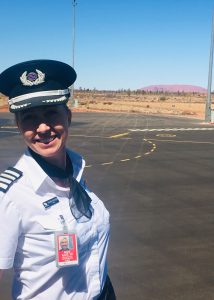
Name: Michelle Huntington
Bio: Michelle Huntington spent years flying commercially, including over a decade piloting Boeing 737s for Virgin, after building her hours on smaller propeller planes and a private jet. She got there after a career advisor told her, point blank, that women couldn’t be pilots. We sat down to talk about what it actually took to prove that wrong.