I started my career in Corporate America. As the daughter of immigrants, I thought I had “made it” when I finally achieved the spacious office, the high-functioning team, and the big paycheck. I spent most of my career in Human Resources (HR) in the biotechnology, technology, fintech, and financial services industries.
Spaces that were, and still are, largely male-dominated industries. However, HR was usually led by female leaders. I would look at these women with their perfect hair, pearl necklaces, and gray skirt suits and think, “Is that how I should dress to fit in as well?” I would witness these female leaders in meetings get relegated to largely a listening function without sharing their thoughts and opinions.
When they did speak, they were routinely interrupted by their male colleagues who oftentimes repeated their thoughts and ideas and adopted them as their own.
I would think that my leaders had a confidence problem. They shrunk in rooms with their male counterparts. I told myself I wouldn’t repeat these patterns.
As I moved up the corporate ladder I started to think about how I wanted to present myself in those same rooms where I saw my previous managers unable to truly share their expertise. I knew I didn’t want that to happen to me. I closely watched how my male colleagues behaved and started mimicking their behaviors, their ways of leading because they were getting promotions, they were being asked for their thoughts and ideas, they were succeeding.
So, I slowly started to adopt their style of leadership.
I didn’t wait to be called on in meetings. I jumped in. I didn’t temper my expectations; I held them high. I didn’t shrink to the room; I took up space. I was confident. I was “leading” and I was “successful”.
And I was miserable! Before every meeting, my stomach was upset or in knots. After every meeting I was exhausted. I didn’t understand what was happening, so I looked everywhere I could for a reason. Maybe I was burned out from working too much. Or I was lonely – my husband was in the military and away a lot. Or maybe it was poor nutrition – some days I didn’t have time to eat, so I would grab food on the go.
While I may not have felt great, I was doing well from a career perspective. I was successful on paper. In addition to the title, the money, the prestige, I had the house, the car, the clothes. Externally, I had “made it”.
Internally, I was disconnected. It took me years to figure out what the real issue was.
—
For starters, I realized my previous managers in HR didn’t have a confidence gap. They were conditioned to self-suppress. It wasn’t about lacking the self-esteem to speak up, share their ideas, or interrupt others. It was how they were brought up – to be respectful, polite, not to interrupt others. In following their deeply ingrained conditioning, they came across as meek or inexperienced or lacking, when none of these things were true.
Then, I realized in mimicking the leadership styles of my male peers, I was inauthentic in my leadership. My body sensed this disconnect (the exhaustion, the upset stomach) long before my brain had a chance to catch up. I was performing a role from a place that wasn’t me at all. When I finally changed my leadership style to reflect my values and how I wanted to show up, those symptoms completely vanished. Plus, I was actually respected and valued more.
Now, as an Identity and Alignment coach, I guide high-achieving women to align their external success with their internal fulfillment. Below are the three questions that finally helped me get there, and ones I wish I had asked myself sooner.
1. What does success mean to me?
– Success on paper is very different from sustainable success. The former comes from external expectations and our conditioning. The latter comes from building and living a life that is meaningful to us.
2. Is this my decision or is it coming from my conditioning?
– Neuroscience suggests that before about the age of seven our brains are highly suggestible and impressionable. This is the time we are making meaning of what we’re seeing happen all around us and picking up our conditioning (what’s right and wrong, good and bad, etc.). This conditioning unconsciously drives our decisions as we get older. Understanding whether a choice is made from this place or from an authentic place is key to living a sustainably successful life.
3. What is my body telling me that my mind doesn’t know yet?
– Our bodies are brilliant. They are constantly sending us signals when a decision feels misaligned, a situation doesn’t feel right, or our values are being dismissed. Oftentimes we dismiss these signals because we live in a society that values data and hard evidence, over feelings and intuition. When we tune inward, not only do we make better decisions, but avoid things like burnout, disconnection, and disengagement.
—
For many years I thought something was wrong with me. I thought this was just how life was supposed to be. What I finally learned changed my life in countless ways – we are whole and our lives require recalibration, the ability to realign with our North Star.
What do you need to recalibrate? Remember, you were never broken. You were just disconnected.

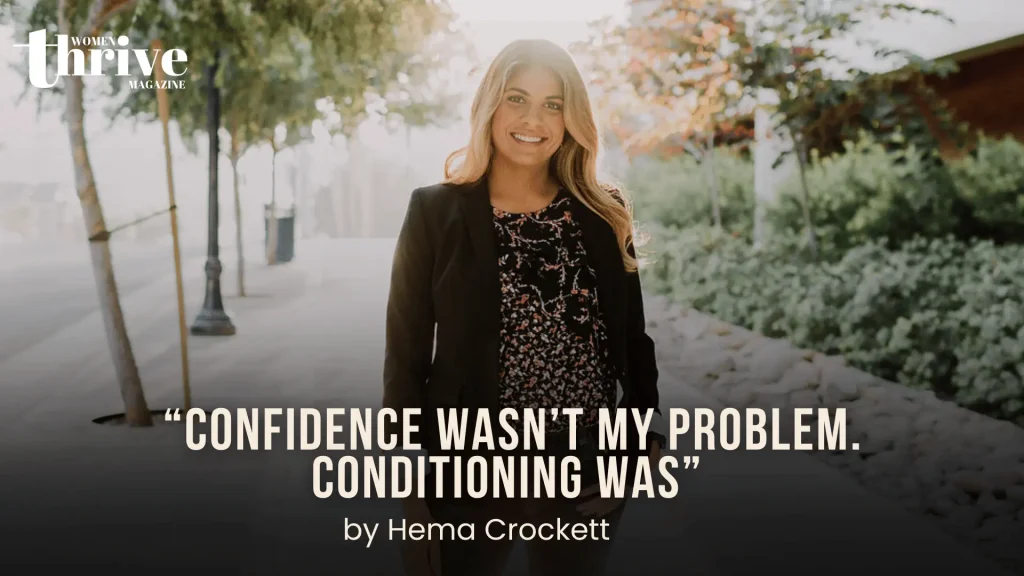
Name: Hema Crockett
Professional Title: Founder, The Recalibrate Practice
Bio: Hema Crockett is an Identity & Alignment Coach, bestselling author, and founder of Recalibrate, who uses neural recalibration, behavioral psychology, and somatic practices to guide high-achieving women through life’s most significant inflection points – helping them shed years of conditioning and “shoulds” to reconnect with who they’ve always been.
Social Media Handles: